
Business problem
The kit starts with behavior, dependencies, users, data, and release reality so architecture follows evidence rather than rewrite momentum.

A runnable public kit turns a legacy .NET request into a framework, package, authentication, data, UI, deployment, parity, rollback, and first-slice decision without pretending a fixture scan proves a production migration.
Runnable demonstrationTSmithCode.ai / CAD Guardian LLCFounder-built public evaluation kit2026
The kit starts with behavior, dependencies, users, data, and release reality so architecture follows evidence rather than rewrite momentum.
Founder-built public evaluation kit
Each risk remains attached to the evidence and owner needed to close it.
Dependency-risk map · parity checklist · first-slice and rollback decision
Private source, credentials, representative data, and production receipts remain scoped engagement evidence.
The kit starts with behavior, dependencies, users, data, and release reality so architecture follows evidence rather than rewrite momentum.
Dependency-risk map parity checklist first-slice and rollback decision
Each risk remains attached to the evidence and owner needed to close it.
Framework version, packages, authentication, UI surface, database access, deployment, integrations, and operator-owned behavior become a reviewable inventory.
Open technical detailThe target architecture is accepted only with representative scenarios, data effects, permissions, integrations, diagnostics, deployment, support ownership, and reversal defined.
Open technical detailDependency-risk map
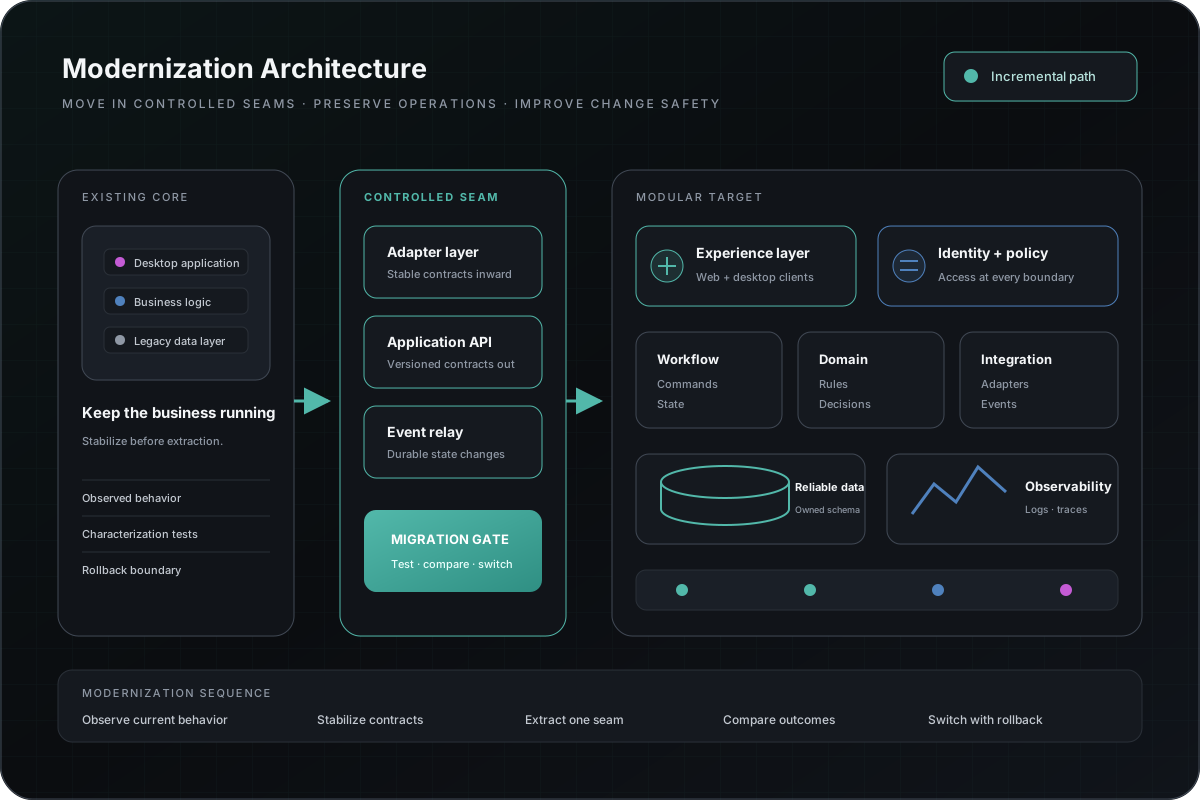
Modernization advances through behavior-backed slices with explicit compatibility, release, rollback, and ownership controls.
Start with the users, trusted behavior, data, integrations, release risk, and the first result worth implementing.
Review authorship, inputs, constraints, rules, outputs, integrations, validation, metrics, and source context in directly linkable technical sections.
Framework version, packages, authentication, UI surface, database access, deployment, integrations, and operator-owned behavior become a reviewable inventory.
Lets a buyer fund the smallest evidence-backed modernization boundary instead of an unbounded rewrite.
Modernization advances through behavior-backed slices with explicit compatibility, release, rollback, and ownership controls.
Behavior-backed modernization architecture — Current public runnable proof · 2026. First-party diagram paired with the public modernization fixture and report.
The target architecture is accepted only with representative scenarios, data effects, permissions, integrations, diagnostics, deployment, support ownership, and reversal defined.
Keeps modernization success tied to operating behavior and supportability, not a new framework label.
Modernization advances through behavior-backed slices with explicit compatibility, release, rollback, and ownership controls.
Behavior-backed modernization architecture — Current public runnable proof · 2026. First-party diagram paired with the public modernization fixture and report.
Current public runnable proof · 2026. Public TSmithCode .NET modernization proof kit and generated quick-start report.
Current public runnable proof · 2026. public .NET modernization proof-kit fixtures
Publication limit: The public kit uses synthetic fixtures and demonstrates an evaluation method, not a customer deployment. Private systems, source, credentials, production data, and live-environment claims require a scoped review.
Current public runnable proof · 2026. repeatable verification command
Publication limit: The public kit uses synthetic fixtures and demonstrates an evaluation method, not a customer deployment. Private systems, source, credentials, production data, and live-environment claims require a scoped review.
Current public runnable proof · 2026. generated modernization risk report
Publication limit: The public kit uses synthetic fixtures and demonstrates an evaluation method, not a customer deployment. Private systems, source, credentials, production data, and live-environment claims require a scoped review.
Start with the users, current workflow, accepted output, failure mode, connected systems, and the first implementation decision.