
Business problem
The proof begins with source and decision ownership before proposing transport or tooling.
Public data-integration and reporting fixtures make source ownership, field mapping, nulls, duplicates, validation, lineage, reconciliation, exceptions, retries, and decision-safe reporting inspectable before live credentials or customer exports are introduced.
Runnable demonstrationTSmithCode.ai / CAD Guardian LLCFounder-built public evaluation kit2026
The proof begins with source and decision ownership before proposing transport or tooling.
Founder-built public evaluation kit
Exception and support ownership are first-class outputs.
Field lineage · visible exceptions · reconciliation and support ownership
Credentials, exports, live traffic, and customer data stay outside the public kit.
The proof begins with source and decision ownership before proposing transport or tooling.
Field lineage visible exceptions reconciliation and support ownership
Exception and support ownership are first-class outputs.
The fixture names authoritative sources, targets, field meaning, nullability, transforms, and exception ownership.
Open technical detailReporting quality is tested as a decision boundary, not judged by dashboard appearance.
Open technical detailField lineage
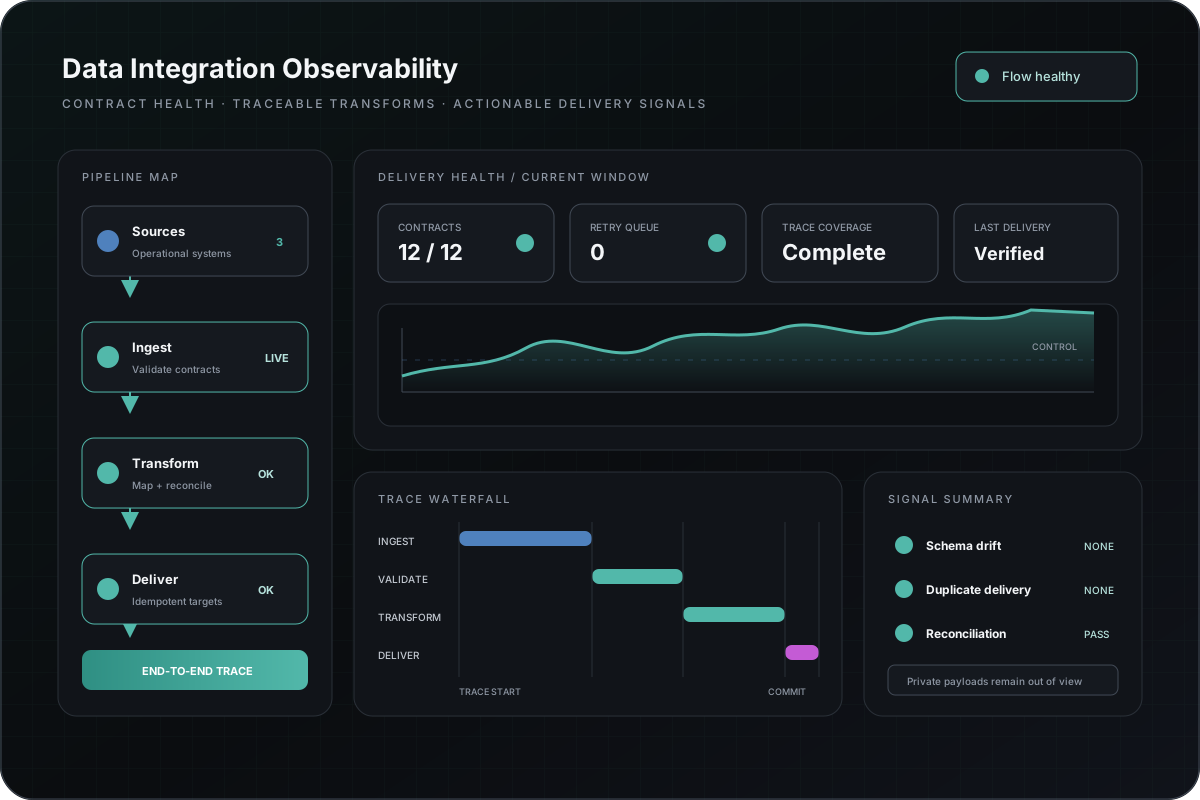
Integration becomes supportable when ownership, contract state, reconciliation, retries, and exceptions share one operating view.
Start with the users, trusted behavior, data, integrations, release risk, and the first result worth implementing.
Review authorship, inputs, constraints, rules, outputs, integrations, validation, metrics, and source context in directly linkable technical sections.
The fixture names authoritative sources, targets, field meaning, nullability, transforms, and exception ownership.
Prevents integration work from starting before field authority and failure ownership are known.
Integration becomes supportable when ownership, contract state, reconciliation, retries, and exceptions share one operating view.
Source-to-report reconciliation and exception model — Current public runnable proof · 2026. First-party diagram paired with public data/reporting fixtures and verifier output.
Reporting quality is tested as a decision boundary, not judged by dashboard appearance.
Makes it possible to decide whether a report is safe enough for the decision it supports.
Integration becomes supportable when ownership, contract state, reconciliation, retries, and exceptions share one operating view.
Source-to-report reconciliation and exception model — Current public runnable proof · 2026. First-party diagram paired with public data/reporting fixtures and verifier output.
Current public runnable proof · 2026. Public TSmithCode data-integration and reporting-quality proof kits and quick-start report.
Current public runnable proof · 2026. public data-integration proof-kit fixtures
Publication limit: The public kit uses synthetic fixtures and demonstrates an evaluation method, not a customer deployment. Private systems, source, credentials, production data, and live-environment claims require a scoped review.
Current public runnable proof · 2026. public reporting-quality fixtures
Publication limit: The public kit uses synthetic fixtures and demonstrates an evaluation method, not a customer deployment. Private systems, source, credentials, production data, and live-environment claims require a scoped review.
Current public runnable proof · 2026. repeatable verification and structured report
Publication limit: The public kit uses synthetic fixtures and demonstrates an evaluation method, not a customer deployment. Private systems, source, credentials, production data, and live-environment claims require a scoped review.
Start with the users, current workflow, accepted output, failure mode, connected systems, and the first implementation decision.