
Business problem
The proof asks what the model may assist, what it may never decide, and who owns every accepted output.

A public technical demonstrations turns an AI idea into allowed inputs, prohibited data, generated-output rules, deterministic checks, reviewer responsibility, correction, rejection, fallback, logging, and an adoption gate without claiming model correctness or production use.
Runnable demonstrationTSmithCode.ai / CAD Guardian LLCFounder-built public evaluation kit2026
The proof asks what the model may assist, what it may never decide, and who owns every accepted output.
Founder-built public evaluation kit
Deterministic controls remain outside the model where possible.
Visible review · correctable output · defined fallback and owner
Privacy, evaluation, reviewer capacity, fallback, provider change, latency, and cost stay explicit.
The proof asks what the model may assist, what it may never decide, and who owns every accepted output.
Visible review correctable output defined fallback and owner
Deterministic controls remain outside the model where possible.
The fixture distinguishes assistance from authority and keeps consequential decisions outside the model.
Open technical detailDeterministic checks remain outside the model and reviewer effort is part of the adoption decision.
Open technical detailVisible review
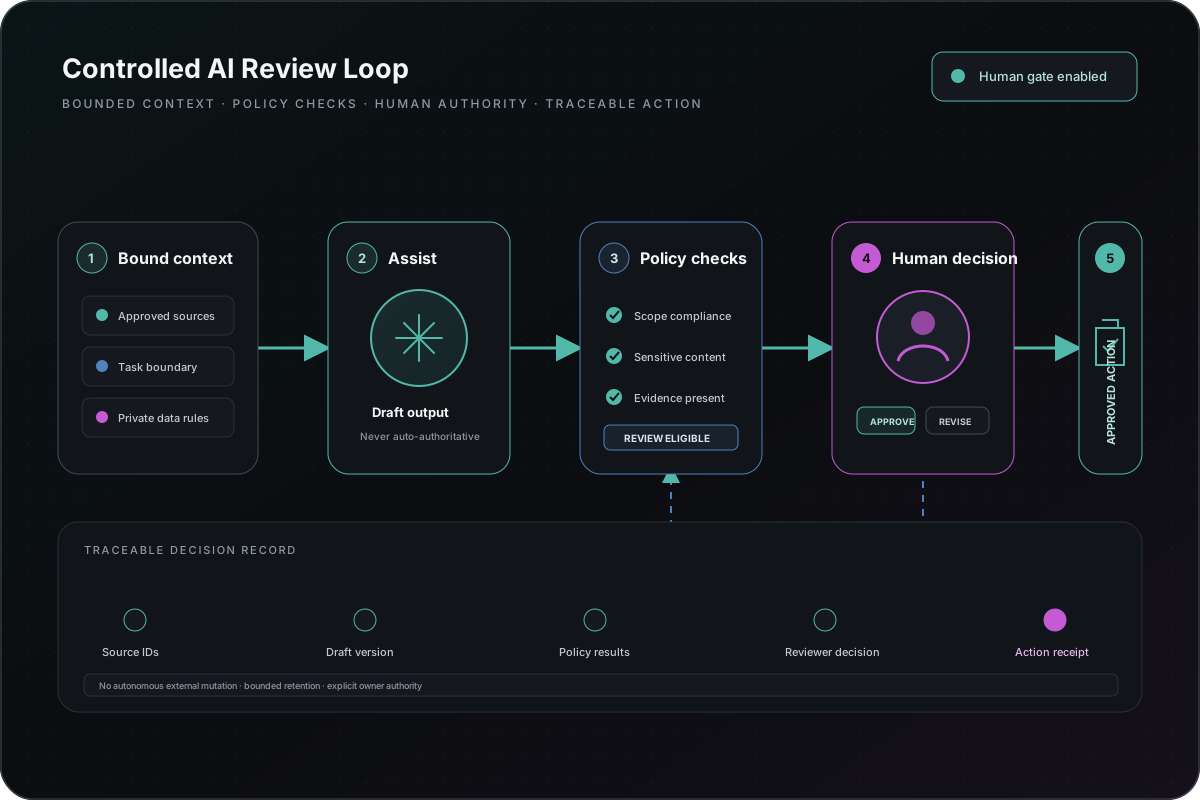
Probabilistic output stays inside a bounded review loop with evaluation, correction, fallback, privacy, and cost controls.
Start with the users, trusted behavior, data, integrations, release risk, and the first result worth implementing.
Review authorship, inputs, constraints, rules, outputs, integrations, validation, metrics, and source context in directly linkable technical sections.
The fixture distinguishes assistance from authority and keeps consequential decisions outside the model.
Prevents an AI demonstration from quietly becoming an undefined production authority.
Probabilistic output stays inside a bounded review loop with evaluation, correction, fallback, privacy, and cost controls.
Approved context, evaluation, human review, correction, and fallback loop — Current public runnable proof · 2026. First-party diagram paired with public synthetic workflow-boundary fixtures.
Deterministic checks remain outside the model and reviewer effort is part of the adoption decision.
Makes review cost, correction, failure handling, and non-AI continuity visible before adoption.
Probabilistic output stays inside a bounded review loop with evaluation, correction, fallback, privacy, and cost controls.
Approved context, evaluation, human review, correction, and fallback loop — Current public runnable proof · 2026. First-party diagram paired with public synthetic workflow-boundary fixtures.
Current public runnable proof · 2026. Public TSmithCode AI workflow-boundary proof kit and structured quick-start report.
Current public runnable proof · 2026. public AI workflow-boundary fixtures
Publication limit: The public kit uses synthetic fixtures and demonstrates an evaluation method, not a customer deployment. Private systems, source, credentials, production data, and live-environment claims require a scoped review.
Current public runnable proof · 2026. synthetic input policy and review rubric
Publication limit: The public kit uses synthetic fixtures and demonstrates an evaluation method, not a customer deployment. Private systems, source, credentials, production data, and live-environment claims require a scoped review.
Current public runnable proof · 2026. repeatable verification and structured report
Publication limit: The public kit uses synthetic fixtures and demonstrates an evaluation method, not a customer deployment. Private systems, source, credentials, production data, and live-environment claims require a scoped review.
Start with the users, current workflow, accepted output, failure mode, connected systems, and the first implementation decision.